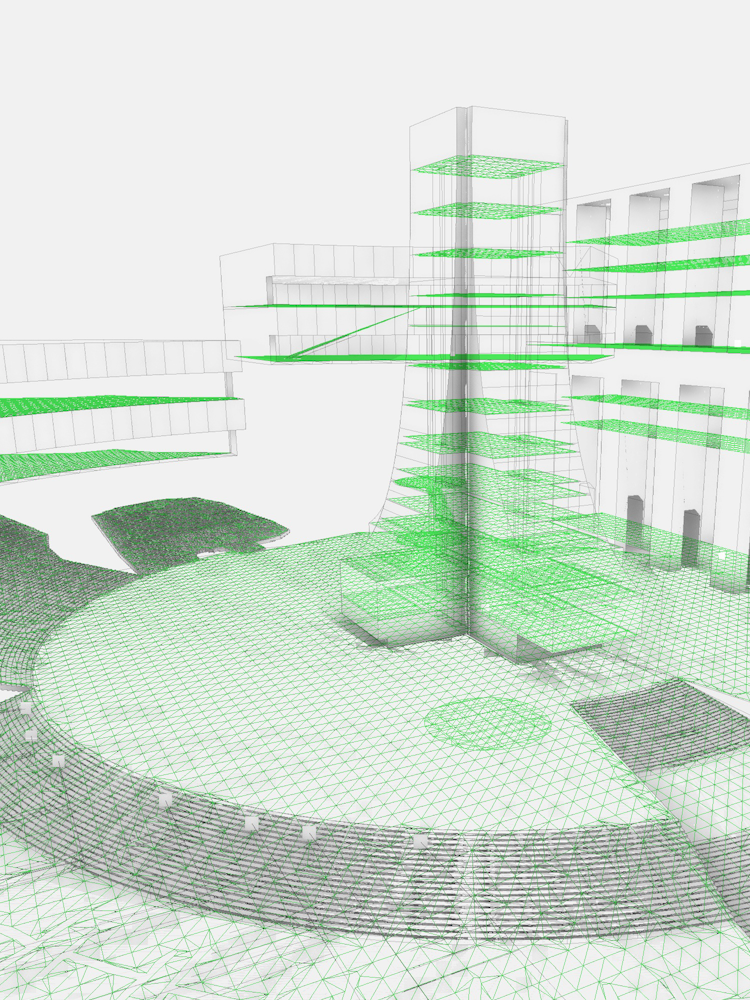
virtual city, personally designed with Rhino/Grasshopper

AGENT BASED MODEL FOR URBAN SIMULATIONS

a web-based, 3D simulation environment for exploring emergent behavior in urban systems using agent-based models and AI agents


role: end-to-end design and engineering

team: D.Jacobs, N.Dellic, K.Larson, L3Cities

technology: three.js, ts, rhino, llms

date: 2024 - present

3DMCowboy is an agent-based simulation platform for exploring emergent behavior in urban environments that integrates game-engine technologies and large language models. Cities are abstracted into interacting agents governed by spatial and behavioral rules, allowing system-level dynamics to arise from local interactions. The platform enables rapid scenario exploration by adjusting constraints and parameters, revealing nonlinear effects that are difficult to reason about through static metrics alone. Built in TypeScript and Three.js, the interface serves as a real-time analytical surface for observing and comparing system behaviors.

model processing

Users can tag geometry with metadata and ground models with real-world context using custom plugins for Rhino.

From this tagged geometry, the engine generates a multi-level navmesh for any 3D CAD model, accounting for both static architecture and dynamic elements such as elevators and transit lines.

The navmesh is then analyzed to extract environmental qualities such as illumination or spatial enclosure — which feed into agent wayfinding, spatial assessments, and layout optimizations.
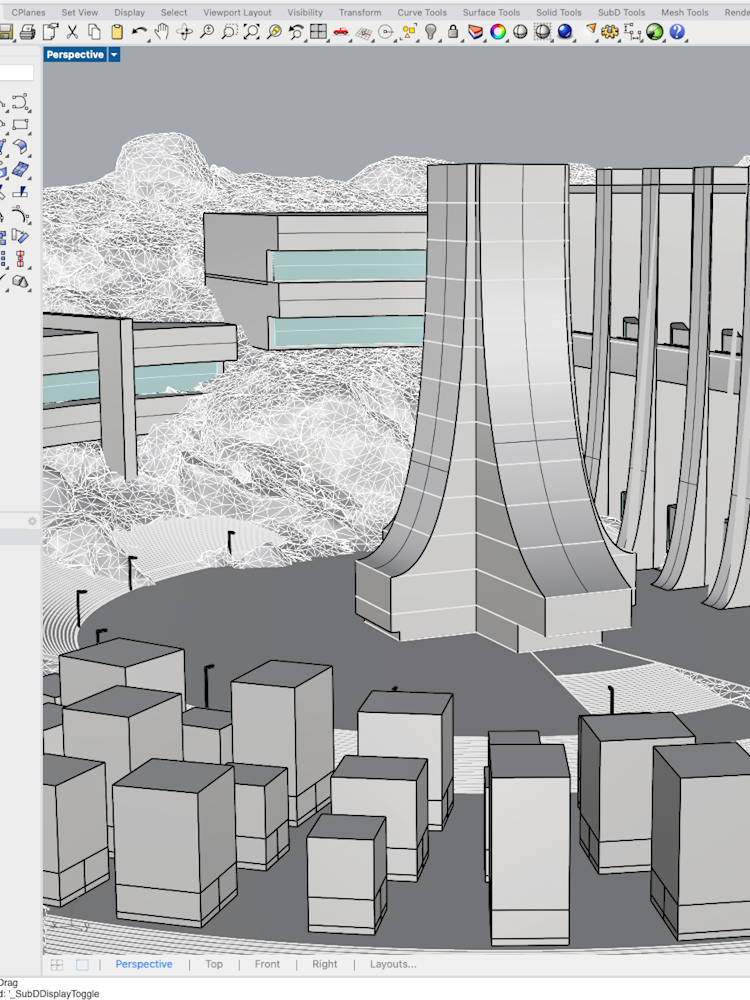
virtual city in Rhino

fig 1: tagged model in CAD

fig 2: navmesh and spatial qualities analysis

fig 3: deployed simulation

agent behavior and intelligence

Agents are a representative sample of the population of interest, such as residents, workers, or visitors, each with unique profiles, relationships, constraints and daily schedules.

Agents select paths and move according to research-based behavioral models conditioned on their preferences and constraints. This includes age, group behavior, and environmental variables such as weather and time of day.

Other dynamic objects, such as vehicles, elevators and public transport, are also modeled and can be analyzed.

Additional detail comes from AI-agent simulacra.

fig 1: realistic populations and schedules can be generated from real urban data or a LLM

fig 2: some agent behavior is based on scientific models of human behavior, [above] a function balances wait time vs climb based on empirical data

3DMCowboy

fig 3: a sophisticated two-tier artificial intelligence system combines large language models and rule-based systems to enables agents to perceive, reason, interact and respond to the enviroment in real-time. [above] hot spots of social activity

analytics

Each agent's movement, speed, and fatigue are governed by biomechanical and behavioral models —energy expenditure, Weidmann speed, local steering behaviors, real-time path replanning, perceptual wayfinding heuristics— that together produce emergent patterns.

As the simulation progresses, the system tracks metrics across space and time and renders them as heatmaps in real-time, a selection of which are shown here.

Together, these layers let a designer see not just where and when people go, but why they slow down, where they linger, what they can reach, and how the built environment performs under realistic behavioral load.

movement patterns

pedestrian congestion

city noise

dwell time

occupancy

footfall

queue wait times

pedestrian fatigue

storytelling

The simulation also allows for experiential storytelling.

Director mode lets users compose cinematic sequences — camera position, angle, and timing keyframed across the environment — to narrate at a macro scale.

Follow mode attaches the camera to any individual agent, revealing their third-person journey through the space as a continuous lived experience.

FPV mode goes further, placing the user inside the agent's body with full manual look control, making the environment felt rather than measured.

Together, these modes bridge the gap between data-driven evaluation and the embodied intuition designers rely on to make good decisions.

director mode

projects/3dm-cowboy/01